
Author: Carolyn Kent ACPSEM
The game of football is the most popular sport in the world and according to the official FIFA website there are approximately 16.6m women and girls playing organised football (1). FIFA’s 2023 associations survey stated there are 19,064 registered professional players and 55,622 clubs globally (1). To put this into context, Liverpool’s Anfield stadium has a total capacity of 61,000 following the expansion of the Anfield Road stand, if every club took a seat there would still be over 5,000 seats spare.
But it’s growing, this is good, right?
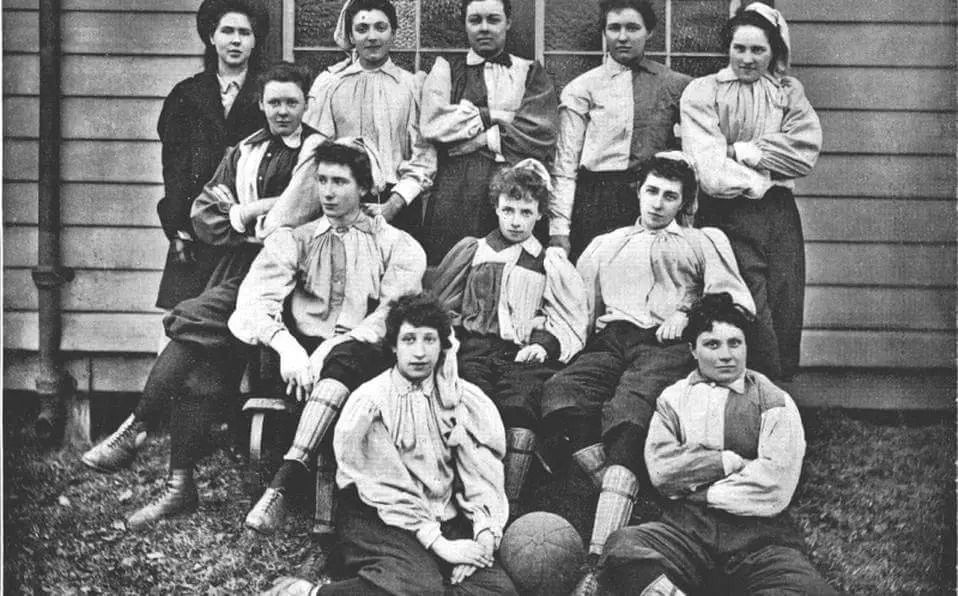
Yes, this is good. However, this is where we need to acknowledge the history of women’s football. Women’s football is not a ‘new’ sport. We can trace women’s involvement in football back to somewhere between the 1840s and mid 1860s where we know women were involved with promotion of football (3). The first recorded women’s football game was on the 7th of May 1881 where a ‘Scotland’ side played an ‘England’ side at Easter Road stadium, the home of Scottish side Hibernian (4). The verification of the birth countries of the players has however been called into question, hence the quotation marks. Eventually, there was a British Ladies team (pictured).
The British Ladies Football Team, 1895. Source: Public Domain.
The Great War (1914-1918) & Dick, Kerr & Co
World War I is a significant event in the history of women’s football. As women were required to enter the work force they took on traditionally male jobs like working in factories and sporting activity was encouraged for health and wellbeing (4). Most of the factories had teams and by far the most successful was the factory team from Dick, Kerr & Co. Preston’s Dick Kerr Ladies was formed and teams started to play in organised football matches which also served to raise money for charity. Christmas day 1917, 10,000 people came to Deepdale, the home of Preston F.C where Dick Kerr Ladies played Arundale Coulthard Foundry. The match raised £600 for wounded soldiers (5). Even after the war their popularity continued with their 1920 boxing day match being believed to have drawn a much larger crowd than their male counterparts (6).
The FA Ban (5th of December, 1921)
By 1921 the popularity of the women’s game was at its height with 150 clubs and some matches attracting 45,000 supporters (4). Even after the war the demand and popularity for the women didn’t fade and some perceived this as a threat to the male game (6). It was questioned whether football was damaging for women’s health with Harley Street’s Dr Mary Scharlieb describing football as the “most unsuitable game, too much for a women’s physical frame” and Dr Elizabeth Sloan Chesser stated: “There are physical reasons why the game is harmful to women. It’s a rough game at any time, but it is much more harmful to women than men. They may receive injuries from which they may never recover” (5). On the 5th of December 1921 the FA met and announced that women’s teams were to be banned from playing at any professional ground or any pitches of clubs affiliated to the FA stating “the game of football is quite unsuitable for females and ought not to be encouraged” (4). This effectively killed women’s football as a sport, relegating the game to public parks. Astonishingly, the ban stood until 1970 in England and 1974 in Scotland (7).
Injury time – Final thoughts
So there you have it, a very short whistle stop tour of the history of women’s football. If you are interested in learning more i’d recommend the work of Professor Jean Williams. Her book the history of women’s football is a great read.
While now it is now universally acknowledged that the ban was wrong and did extensive harm to the women’s game, many associations are now heavily investing in women’s football and the game is growing quickly. It should not be forgotten however, that medical professionals opinions were utilised to justify the ban. Going forward there must be an investment in research into the issues female athletes face within the sport. One day hopefully, we won’t even say women’s or men’s football, it’ll just be football.
Have something to share?
If you’d like to contribute a blog or appear on our podcast for women’s football hub, please contact us at: Info@womensfootballhub.com
References
- Grow the participation [Internet]. [cited 2024 Jun 17] Available from: https://inside.fifa.com/womens-football/member-associations-survey-report-2023/grow-the-participation
- Plans – Expanding the Anfield Road Stand [Internet]. [cited 2024 Jun 17]. Available from: https://www.liverpoolfc.com/anfieldroadexpansion/plans
- WILLIAMS J. History of women’s football. S.l.: PEN & SWORD HISTORY; 2023.
- The Football Association. Kicking down barriers [Internet]. [cited 2024 Jun 17]. Available from: https://www.thefa.com/womens-girls-football/heritage/kicking-down-barriers
- Dick, Kerr LadiesT.M. [Internet]. [cited 2024 Jun 17]. Available from: https://www.dickkerrladies.com/
- Kightly, C. The history of Women’s football in England [Internet]. 2024 [cited 2024 Jun 17]. Available from: https://heritagecalling.com/2023/08/03/the-history-of-womens-football-in-england/
- First Women’s international match 1972 [Internet]. [cited 2024 Jun 17]. Available from: https://www.scottishfootballmuseum.org.uk/news/first-womens-international-match-1972/#:~:text=Since%201921%2C%20the%20Scottish%20F.A.,only%20assumed%20responsibility%20in%201998.
 Women's Football Hub
Leave a comment