

Editor Carolyn Kent – Women’s Football Hub
Introduction
In this episode of the Women’s Football Hub podcast, I sat down with Emma Sconce, a former footballer, teacher, and researcher who has just completed her PhD at Sheffield Hallam University. Her research focuses on hamstring injuries and function, a critical issue in football given the high rate of hamstring strains in both male and female players.
Emma’s journey has taken her from playing with Burnley, Doncaster Belles, Bradford City, and Manchester City, to competing in the USA and later pursuing a career in strength and conditioning research. Her insights are crucial in understanding injury prevention and rehabilitation strategies in women’s football.
The Journey from Player to Researcher
Emma’s transition from playing football to research was largely inspired by her time in the United States, where she was introduced to a more advanced strength and conditioning culture. This exposure fuelled her passion for sports science and led her to pursue a Master’s degree in Strength and Conditioning at Salford University, ultimately culminating in her PhD on hamstring injuries.
She observed that while the women’s game has progressed, the increasing physical demands on players have led to a rise in injuries. The lack of injury prevention strategies in early playing years has long-term consequences, with many players retiring early due to injuries that could have been managed or prevented.
Understanding Hamstring Injuries in Women’s Football
Hamstring injuries are one of the most common lower-limb injuries in football, often occurring during sprinting, acceleration, and deceleration movements. Studies suggest that a typical squad of 25 players experiences six to seven hamstring injuries per season, with a recurrence rate of up to 63% within two years of return to play.
A significant issue is the lack of female-specific research in this area. Most hamstring injury studies have historically focused on male athletes. However, a recent UEFA study following nearly 600 elite female players found that women’s teams can expect 35 time-loss injuries per season, with hamstring injuries making up 12% of those.
Emma warns that if trends in women’s football follow those in the men’s game, hamstring injuries could double in the next 20 years, making targeted injury prevention strategies crucial.
The Role of the Nordic Hamstring Exercise in Injury Prevention
Emma’s research focuses on the Nordic Hamstring Exercise (NHE), which has shown significant benefits in reducing injuries: ✅ 51% reduction in first-time hamstring injuries
✅ 86% reduction in recurring injuries
The NHE involves slowly lowering the body from a kneeling position while keeping the trunk straight, engaging the hamstrings eccentrically. However, compliance and practicality issues have led to low uptake in many teams.
A key finding from Emma’s research is the concept of the breakpoint angle, which refers to the knee angle at which a player can no longer control their descent. Measuring this can help tailor training to improve hamstring strength at longer muscle lengths—a vital factor in injury prevention.
The HAL-HAM System – A Breakthrough in Injury Prevention
As part of her research, Emma and her team at Sheffield Hallam University have developed the HAL-HAM system, a device designed to improve hamstring training effectiveness.
🔹 Innovative Features:
✔️ Measures knee angles to track hamstring strength and failure points
✔️ Allows inclined Nordic exercises, making it easier to target hamstrings at longer lengths
✔️ Provides real-time feedback for improved technique and injury prevention
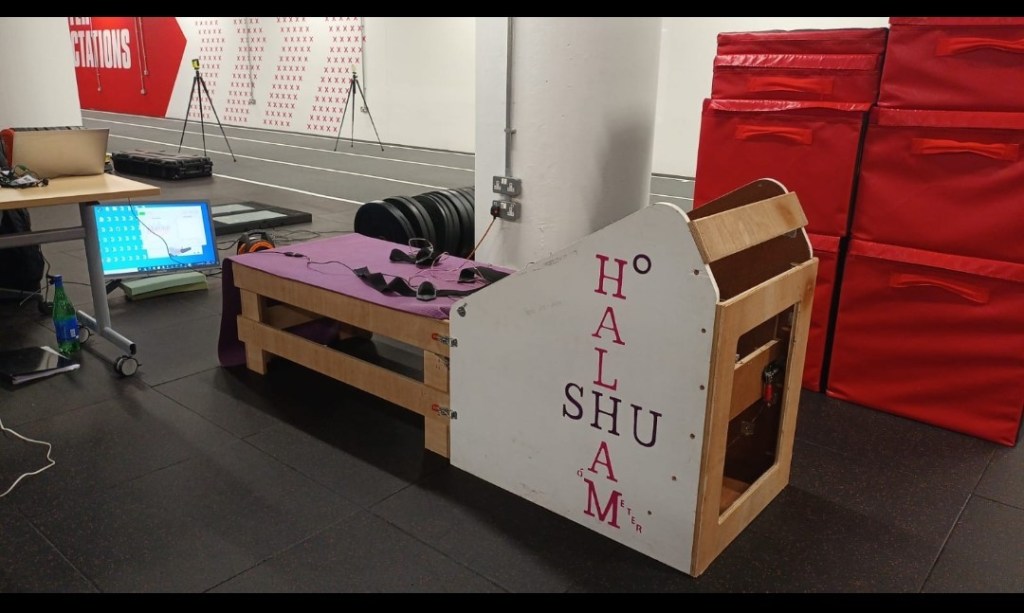
Emma hopes to see the HAL-HAM system implemented in large-scale research studies, particularly in women’s football, to assess long-term injury risks and optimise training interventions.
Common Mistakes in Injury Prevention & How to Fix Them
Emma highlights some of the most common mistakes players and coaches make regarding hamstring injury prevention:
❌ Skipping proper warm-ups and cool-downs – This increases injury risk significantly.
❌ Neglecting eccentric strength training – Hamstrings need to be trained under high tension, mimicking real match conditions.
❌ Ignoring workload management – Overloading players with intense schedules without adequate recovery leads to chronic injuries.
❌ Returning to play too soon – Players often come back before regaining full hamstring function, leading to reinjury.
✅ Emma’s Top Tips for Hamstring Health:
✔️ Consistency is key – Incorporate the Nordic Hamstring Exercise into regular training (2 sets of 4 reps weekly).
✔️ Strength and conditioning must be prioritised, even at youth levels.
✔️ Educate players on proper nutrition, recovery, and individual responsibility for injury prevention.
The Future of Women’s Football & Injury Prevention
Looking ahead, Emma hopes to see greater investment in research and resources tailored to female players, including:
- Enhanced injury prevention programmes designed for women’s biomechanics.
- Better medical and sports science support at all levels.
- Greater visibility and equity in football, ensuring player welfare is prioritised.
She also hopes to commercialise the HAL-HAM system, making it accessible to teams and athletes looking to improve hamstring strength and reduce injuries.
Final Thoughts & Advice for Aspiring Researchers
Emma’s final piece of advice for women in football and research:
💡 Stay passionate and persistent – Football and academia are competitive, but if you love what you do, you’ll find success.
💡 Step outside your comfort zone – Seek opportunities and advocate for yourself, even in male-dominated fields.
💡 Surround yourself with great people – A strong network of mentors and teammates makes all the difference.
As Emma prepares for her PhD Viva, her research has the potential to shape the future of hamstring injury prevention in women’s football.
📢 Want to learn more about HAL-HAM? Follow Emma’s updates on LinkedIn and Twitter.
🎧 Listen to the full Women’s Football Hub Podcast episode now!
#WomensFootball #InjuryPrevention #HamstringHealth #FootballScience
This blog post was created with assistance from ChatGPT, an AI language model developed by OpenAI (OpenAI, 2025).
 Women's Football Hub
Leave a comment