Editor Carolyn Kent Women’s Football Hub
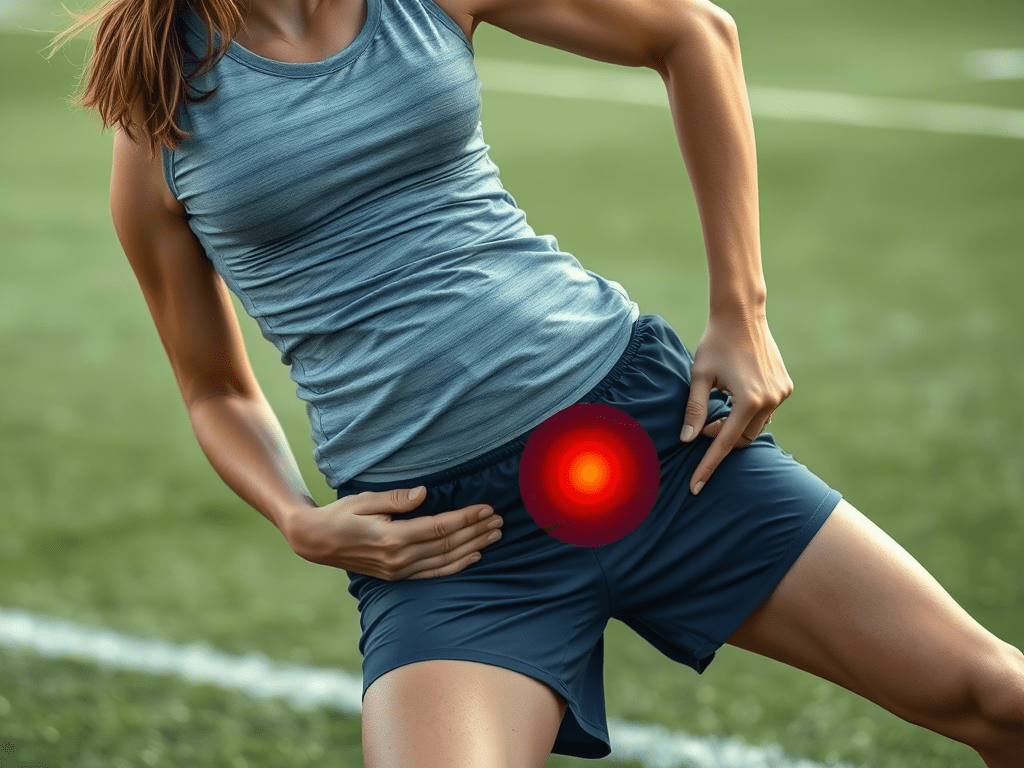
Groin pain is a common yet complex issue in football, affecting players across all levels of the game. Despite its prevalence, it remains one of the most challenging areas to assess and rehabilitate. In a recent episode of Women’s Football Hub, physiotherapist and PhD researcher Christos Pippas shared his expertise on longstanding groin pain, offering valuable insights into diagnosis, rehabilitation, and the future of groin injury management.
Categorising Groin Pain: The Consensus Framework
Christos began by outlining the classification system established by the Doha Agreement (2015) and refined by the ESCA Consensus (2024). These frameworks divide groin pain into four main categories:
- Adductor-related groin pain – pain and tenderness in the adductor muscles.
- Iliopsoas-related groin pain – pain in or around the iliopsoas muscle.
- Pubic-related groin pain – pain in the pubic bone or adjacent areas.
- Inguinal-related groin pain – irritation in the inguinal canal without palpable hernias.
This classification helps clinicians navigate the anatomical complexity of the groin region and guides targeted assessment and treatment.
Clinical Examination: The Cornerstone of Diagnosis
According to Christos, effective diagnosis begins with basic clinical tools: palpation, resistance testing, and stretching. These methods help differentiate between the various types of groin pain. For example, tenderness and pain during resisted adduction point toward adductor-related groin pain, while pain during iliopsoas resistance or stretching suggests iliopsoas involvement.
Inguinal-related pain, which lacks muscular structures in the area, may present with abdominal symptoms and requires careful examination of the inguinal canal. Christos emphasised that clinical examination should always take precedence over imaging, noting that scans can reveal abnormalities even in asymptomatic athletes.
“I base my clinical examination and my opinion on clinical examination rather than imaging in itself.”
Rehabilitation: Building Strength and Function
Christos’s approach to rehabilitation is grounded in progressive loading and functional adaptation. He recommends starting with isometric exercises, such as adductor squeezes using a football, especially for athletes experiencing high levels of pain. These exercises allow for safe tissue loading without exacerbating symptoms.
Once pain is controlled, athletes can progress to more dynamic exercises. The Copenhagen Adduction Exercise is a widely used tool for increasing eccentric strength in the hip adductors. However, Christos cautions that it may not be suitable for all athletes, particularly those who are undertrained or in pain.
“You have to find something that keeps the pain low but at the same time builds tissue adaptation.”
He also advocates for functional loading, including slow running and controlled movement patterns, always keeping pain within a safe range typically 2–3 out of 10. This ensures that the tissue adapts to the demands of football without risking further injury.
Athlete-Centred Care: Flexibility and Choice
A key theme in Christos’s philosophy is individualisation. He encourages clinicians to offer athletes a choice of exercises that meet specific rehabilitation goals, such as strength development or functional movement.
“You have to present two or three different exercises to them so they can choose one. These exercises have to have certain characteristics.”
This approach not only improves compliance but also respects the athlete’s preferences and psychological readiness, which are crucial in rehabilitation.
Common Mistakes: Overcomplication and Lack of Function
Christos warns against overcomplicating rehabilitation. He believes that many mistakes stem from ignoring basic principles and failing to integrate functional movements into rehab plans.
“We think very complicated. We don’t stick to the basics.”
He stresses the importance of combining strength work with functional exercises that mimic the demands of football, such as multi-directional movements and gradual return to running.
Return to Play: No Universal Criteria
Unlike ACL rehabilitation, groin pain lacks standardised return-to-play protocols. Christos relies on a combination of clinical examination and functional readiness to guide progression.
“There is no specific criteria for return to running. You have to complete the previous step before moving forward.”
This includes ensuring that the athlete can tolerate slow running and directional changes without pain, and that the tissue has adapted to increased loading.
Research Gaps: Women’s Football and Prevention
Christos highlighted the lack of research in women’s football, particularly in groin pain prevention and rehabilitation. While men’s football has more established data, the female game remains underrepresented in the literature.
“We are just trying to get on top of that research-wise, especially in women’s football. We have really poor research on that.”
He also noted that prevention strategies are still evolving, with limited evidence on the effectiveness of specific exercises. His current PhD work aims to develop a rehabilitation protocol that bridges the gap between research and clinical practice.
Final Advice for Clinicians
Christos’s advice to young physiotherapists and coaches is clear: stick to the basics, think clinically, and adapt to the athlete.
“You have to bridge the gap between clinical practice and research. This is the best advice I could give.”
By focusing on foundational principles, respecting the athlete’s experience, and staying informed about emerging research, clinicians can improve outcomes for athletes dealing with groin pain.
Conclusion
Groin pain may be complex, but with the right tools and mindset, it can be effectively managed. Christos Pippas’s insights offer a practical, evidence-informed approach to assessment and rehabilitation, grounded in clinical reasoning and athlete-centred care. As research continues to evolve especially in women’s football clinicians must remain adaptable, curious, and committed to best practice.
This blog was generated with the assistance of AI and edited by podcast host Carolyn Kent to ensure accuracy and relevance.
Hashtags: #GroinPain #FootballInjuries #SportsMedicine #Physiotherapy #CopenhagenExercise #InjuryPrevention #WomensFootball #ClinicalPractice #ChristosPippas #FootballRehab #EvidenceBasedPractice #AthleteCare #ReturnToPlay #SportsRehab
 Women's Football Hub
Leave a comment